Google's AI is really intrusive. That's the only way to describe it.
I searched for "weather <my town>", I get an AI saying the current weather is 33C. It says monday will be 41C. Like I live in the desert. Google's actual weather widget, which appears BELOW the weather overview and gathers data from accurate sources, says 26C. How hard is it to block the "weather" keyword from triggering the AI overview when you already have a perfectly functional weather widget?
Also, because before we used to have a tool, there was even some sense of privacy in using that tool. Now with these LLM's pretending to be human, it feels like entering a store and instead of being allowed to browse things in peace a clerk starts pressing you about what you want in order to make themselves useful. At that moment the "privacy" of being able to just mind your own business, alone, vanishes. It's intrusive. And it becomes extremely clear how intrusive it is whenever you search for something by typing something to the SEARCH TOOL and the AI misinterprets it as YOU TALKING TO THEM AS A PERSON, e.g. if you type "how are you" and it says back "I am doing well, thank you for asking!" and things like that. Companies seem not to care about being as intrusive as possible in people's lives, it seems.
Maybe this is something cultural. iirc in America clerks are very proactive with interacting with customers, while in countries like Germany it's the opposite and they keep their distance.
The specific issue is that search has become so bad that they think an LLM that gets answers wrong half of the time is a valid alternative, or, in fact, the "future" of search. Then they shoved that "alternative" to users with no way to disable it.
Maybe more and more teachers care less and less about training students to take tests, and care more about actually educating students in the subject matter. So maybe the plunging test scores are are simple as “students are worse at taking tests.”
No. My take is that test scores are a lousy measure of education. Maybe students are indeed learning less, and that would be worrying, but while we measure that using test score we simply cannot control for test taking ability.
Not necessarily. Test taking is a skill in its own right. The PISA test is for example 4 hours long, and students might not have the endurance to stay focused reading text that doesn’t matter and answering questions they don‘t care about for 4 whole hours.
Not being able to focus for 4 hours seems like a bigger problem. But it’s also entirely orthogonal to your distinction of “teaching the test” vs “actually educating”. You can’t teach people to focus for 4 hours.
I know I would not be able to focus for 4 hours on a test that doesn’t matter, while reading text I don‘t care about, so that kids are failing that seems like a non-issue to me.
The rest if your point is simply wrong. Focusing is a physical activity that you can train for. Every good chess player that plays classical trains for that. And so do (or rather so did) students in the education system. Taking mock tests before the finals is a way to train your endurance such that you will be better able to keep your focus throughout the test.
> When disagreeing, please reply to the argument instead of calling names. "That is idiotic; 1 + 1 is 2, not 3" can be shortened to "1 + 1 is 2, not 3."
"Modern" education isn't modern at all. It's a leftover from industrialization, aiming at producing easily controllable worker drones.
"Elites" fearing the "plebs" to question them on things they have no good answers for is what constrains active development of actual modern scientific concepts of pedagogy taking hold. You only get to research what is being paid for.
Look at the, pretty obvious, natural human child-mode of learning: playing games.
Just not escapist nonsense games. Games that model relevant aspects of reality in an engaging way. Where you can fail without real-life consequences and learn from it while enjoying yourself.
My kids are very much into games. However, soon as they got old enough to invite friends over, I have learned they are a minority. Most of their friends don’t give a shit.
I mean they are doing some things over at the Alpha School to work on gamification of education that is actually useful for the modern human, but they get a ton of hate for what they are doing, despite the test results speaking for themselves
(they bribe kids, and the lessons are individualized through software).
> Look at the, pretty obvious, natural human child-mode of learning: playing games.
> Just not escapist nonsense games. Games that model relevant aspects of reality in an engaging way. Where you can fail without real-life consequences and learn from it while enjoying yourself.
In a lot of ways, that’s math contests and games like Around The World.
And that’s exactly the type of thing modern educational philosophies have eliminated.
For some reason it’s perfectly fine to have little Johnny show that’s he can run a race faster than the next kid, but he can’t show that he can solve math problems faster.
Playing games as a biological creature optimized to live on plains is great, your body has a lot of the lessons already encoded in DNA.
When it comes catching up to the last 10,000 years of human development everything tends to get a bit trickier. Play is a good way at learning, but as you get to higher concepts you have to learn but are hard to game it gets a lot trickier.
Trying to easily wrap this up as the elites vs you is highly reductive. Before that age you' have spent most of your time and effort making food and clothes, not active research into the world.
They're not wrong though, like, it is a creation of the industrial era, and honestly, the "elites vs all of us" isn't exactly crazy. Mcgraw Hill is literally owned by Apollo Global Management, don't just take my word for it, look up the relationship the management there had with Epstein.
It doesn't have to be a conspiracy even, it could just be that terrible incentives across the board result in terrible outcomes lol
You're right, but with the rhetoric I see espoused about "don't go to college" by most really rich people (who all went to the best schools themselves) the more I think "don't fall for it kids!"
And there may be some social-engineering intent there, or at least something approximating it? Like, I don't think the elites are all smoking cigars after their Bohemian grove owl orgy (or whatever Alex Jones coded nonsense) and saying "muah hahahaha, we can really make these kids dumber!" But I definitely think that "it sure would be nice if the workers didn't want raises" certainly comes up. No child left behind has certainly had an effect too... Then there's the shootings, the bullying (which appears much much better than when I was a kid at least), and the jingoism/patriotic nonsense.
My wife and I have actually been considering taking the kids out of "traditional school" and doing something more bespoke. Here in Alaska that's a lot more practical than in say, Washington? We have great home school programs here, and with our family members we have the education and qualifications to teach most of the core subjects (lots of retired teachers in our extended family). But, even with my kids in a fantastic school, it is a weird and almost carceral experience for the kids. They're constantly waiting around for stuff, constantly being tested with tests that don't seem to make a huge difference in what's taught, and they aren't really reading literature or doing much in math beyond simple rote work except for one of my sons who is 2 years ahead in math but is still bored.
I'm not saying it was all roses when I was in school 20-30 years ago, but, it feels qualitatively different? Also... even in the nice school they're in, the environment is just... I don't know, oppressive, crowded, and restrained. I'm sorry, it's messed up to make kids ask to go to the bathroom or get a drink of water. I'm sorry, it's weird how authoritarian most of the classes are - I understand why, shrinking budgets mean bigger classes, but at least personally, I feel that there's a lot of merit to the idea that this thing that used to be about learning has become daycare so the parents can stay grinding away while their kids are safely sequestered. We will see if we can do it, but we're thinking pretty hard about just travelling in the winter while they do home school online or take college classes.
What's better: to have my kids sit in a box for 7 hours a day (but really only work for like 2-3 hours) and respond to bells on command or to do online school for 3 hours a day, have mom, dad, and grandma lecture on our specialties and guide them through projects that really push them all from another country in the winter where they can learn a second language, see a different world, etc? I understand that this is a privileged position for us - like, I work from my laptop and my wife has a commutable job, but each day I pick up the kids from their school it feels a little more like picking up a parolee.
> We have great home school programs here, and with our family members we have the education and qualifications to teach most of the core subjects (lots of retired teachers in our extended family).
These days you can find online courses and tutors. Lots of one to one adult attention helps a lot but kids can teach themselves a lot too. One problem is qualifications. Here in the UK our kids can just do the same exams school kids do. I think its more complicated in the US?
I think a large part of the problem with schools (and this is why its a problem across many countries) is a greater focus on metrics.
> The two categories of people I know who say this are elite-college graduates and parents of kids who crashed out of their standardized tests.
I mostly see business people who are already successful people saying this to be honest.
> We’ve tried this for decades. What are the data?
Well, the data is that if you can get a private tutor, that's what you should do, it's way more helpful than just going to school for 7 hours a day. That's why were thinking about making a more alternative education style happen. I'm definitely qualified to teach some stuff, and so is my wife, and mother. We just will need to find a way to fill in the gaps of the places where we're not qual'd. Regardless, I think personalized/individualized education is almost always better by the numbers.
That said, it really depends on what you're optimizing for.
I feel like that really depended on where you went? But I suppose my life was different, by the time I was a junior in HS, I was mostly taking shop classes and language classes, had my own car that I had bought with a part time job, and had a color printer that convincingly forged hall passes on demand, so I pretty much did whatever I wanted the last couple years? It worked out fine, I graduated near the top of my class? But the strictures and authoritarian sense seemed to be lower?
I legit had aircraft sheet metal snips and numerous exacto knives in my locker and a leatherman on my person most of the time and it wasn't a huge deal? Hell, I needed the leatherman to open the hood of my shitbox car. In contrast today, one of my kids brought a toy knife to school a few years ago (because he thought it was cool, great learning opportunity for a young kid about "the man" I suppose) and you'd have thought they caught Bin Laden or something?
Perhaps I was just lucky, but it feels way different now, though there seems to be a lot less bullying.
College just doesn't work. They don't know what jobs will be available and they are way too far behind the professional sector to teach about them anyway, with rare exceptions that aren't economically favored for, institutionally.
The system forces schools to increase enrollment by assigning a tuition price based on attaching a loan to it. It's basically for profit. Then, the loans can't be forgiven in bankruptcy when the outcome of the education platform fails to produce an income that supports repayment.
To get an education that doesn't completely screw you over, you need to be a minority with a scholarship or actually have rich parents and attend for fun. But in either case, your only benefit financially is the hope of connecting with other students whose parents are richer than yours.
Exceptions for subjects with artificial barriers of entry (medicine, law, etc., and each of those has its own set of problems, mainly the price of education).
(Speaking about the United States, but probably a lot of this applies to many places.)
I disagree with the sentiment that the rich are dissuading college enrollment. I'm not rich. I don't hire college grads. They are broke, entitled, and lack work ethic. After 5 in a row, I started giving opportunities to smart kids, from good families, who exhibit an appreciation for hard work and good moral character. Those people learn in a month what takes a college grad 6. They appreciate opportunity, instead of expecting it.
As I should have always known, a good person is far, far more valuable than a piece of paper certifying victimhood.
I really have found college valuable, but I also self-funded and have no debt. This is pretty much the arrangement I'm trying to set up for my kids too - when I had a blue-ish collar job (bush pilot is a blue collar job no?) I didn't think school had a lot of value, but then again, looking in hindsight, I'd unironically say that the most "valuable" (scare quotes intentional here) course I took was art history. Not because I learned anything that was economically useful, but it gave me a new way to view the world and literally changed some of the decisions I made with my life?
I agree with the idea of giving opportunities to smart kids from good families who work hard and are ethical. But I also think it's pretty damn hard to get good at certain things outside of a classroom? I don't know, I have mixed emotions.
Still, despite my misgivings with traditional education, I think there remains some good that comes from going to a place where your only job is to learn.
I'm teaching my kids how to build a business, and how to learn chemistry and deep science through self learning programs, like Aleks, and the like. Same curriculum as I got in college.
But none of the loans and none of the "go work for IBM" mentality that taught me how to be a loser for way too long.
A few years head start on actual business building is way more valuable than a 250 kid lecture hall with a teacher who never built anything in their life.
The future belongs to entrepreneurs, and that's even more true now with LLM built businesses.
Get them a face to face sales job for a bit. It does a lot for one's character to learn how to break the ice and be personable. And it teaches work ethic.
That's stupid. People didn't bash the em dash because it was an em dash. They bashed it because it made it obvious it was AI. If your product is so good why are your customers ashamed of using it?
Honest take: people aren't ashamed of using AI, they're trying to avoid being cancelled by rabidly anti-AI ideologues who would hate AI output even if it was the best thing they'd ever seen.
If the problem and implementation is so well defined, and "determnistic", this means that LLMs should also be able to just "write code" from specs, without thinking.
>'Sure AI won't perform as well as our human tutors with all the support behind them, but it's also $30 a month.'
For how long, though.
>Mr Buckland also claimed the tutoring industry doesn't 'actually do anything unique' but instead provides comfort to students - something AI can replicate.
Jesus. That's really not a good thing.
It's not every day you see someone so incredibly dismissive of the product they're selling themselves.
> It's not every day you see someone so incredibly dismissive of the product they're selling themselves.
I believe that considering that AI is much cheaper than their service offering, and thus customers of Dymocks Tutoring and Talent 100 often ask them how much more they are actually offering for the much more expensive price has put this company under a lot of price pressure from customers.
So, I bet that Dymocks Tutoring and Talent 100 wants to change their main service offering to target parents from rich families instead who aren't so stingy.
They can't do that because a CMS under Cloudflare needs to be configured to bust the Cloudflare cache when content is edited or the user will see cached content after they edit a page.
That might be the default configuration if your CMS doesn't return any cache-control headers. But Cloudflare definitely [0] supports must-revalidate and etag or last-modified, which is also probably supported by whatever CMS you're using. HTTP conditional requests are very old and very widely supported.
[0] Okay, my claim is only definite up to my memory of using Cloudflare for a fairly high-traffic circa 2019-2022. I haven't used Cloudflare after that point, but a quick search of their docs shows support
Right. But if the cache MUST be revalidated every time, it's the same thing as being disabled.
The point of a reverse proxy is to reduce load on the server rendering the page. If you GET, the page is rendered. So in order for etag/last-modified to be effective, the CMS must implement HEAD. If the CMS doesn't implement HEAD or implements it in a way that ends up doing all the work of GET anyway, you just end up with more load than just doing a GET every time.
The funny thing is that the way HTTP is designed the simplest PHP script can do this correctly, because the server must send the headers first, so a PHP script can NOT do the work to generate the HTML until it has sent the correct headers, as they won't be able to change the headers after they start sending the body. In theory, the process could just shut down the instant the first body byte starts being sent and save work in a HEAD request. The problem is that pretty much everything works in a more "clever" way: you have some sort of template engine that generates the whole HTML, a view method that makes the DB calls, etc., and only after all the work is done the HTTP headers are sent. Because this method allows the backend to add/change/remove headers at any point during the process, not just at the start.
Essentially the problem is that CF doesn't know what your server is running, and even an s-maxage=60 is going to look like a bug from the user's perspective if they go to /post?id=123, navigate to /edit-post?id=123, edit the post, go back to /post?id=123 and see the post unchanged.
What are you referring to with the origin needing to support HEAD requests? For HTTP conditional requests your origin just needs to support GET with if-none-match or if-modified-since. Then it responds with a 304 with no body if the cached version is still valid. The origin should, of course, be able to determine cache validity much more cheaply than rendering the whole page, which is usually as simple as checking a single timestamp in the database.
And, of course, you can still use cache-control to permit some duration of staleness, so that you don’t literally revalidate on every request.
Nuclear power is not a renewable power source in the technical correct meaning of the word. Fission material is "only" abundant, in that we can win nuclear fission material from many sources, including recycling spent nuclear material, but it is not available and spent without human intervention (otherwise we could argue fossil fuels are renewables, too).
As an aside, nuclear fission power differs from renewable power in many other ways, too. It is not clean, it is not easy to harvest, it is not safe, it is not cheap, it is not a mass job engine, it is not low-maintenance, it has less utility, and it has less flexibility.
IF the world got its primary energy from today's kind of light water reactors, uranium available at up to 3x the current price would only last for about five years.
A fully nuclear-powered world (including all energy use, not just grid electricity) would need breeding of some kind; otherwise the uranium just gets too expensive. So when you hear people claiming nuclear is cheap, ask them if that cheapness includes the technologies that would actually be needed for nuclear to do the full job.
If we needed more nuclear fuel we would be producing more of it. Comparing current production to a world where we use a thousand times more of it is ridiculous. Uranium is not that rare, and spent fuel rods still have well over 90% of their potency so they can be recycled.
Nuclear energy could easily power the entire planet for thousands of years.
Sure, we could produce more. It would have to be from much lower grade ores, and so would be much more expensive and disruptive. This is why breeding would be needed, so the cost of the uranium would not make nuclear even more unaffordable than it already is.
The argument about affordability is quite ridiculous in a world that is becoming uninhabitable as a direct cause of the "affordable" alternatives.
We could easily afford to use nuclear, and we wouldn't have to rely on it entirely - we have many alternatives such as solar, wind, hydro, geothermal etc. I'm also quite confident that economy of scale would improve the fuel cost, and the higher investment would make breeding and other nuclear technology advancements much quicker than they are and have been. Not to mention fuel cost is quite insignificant in nuclear energy.
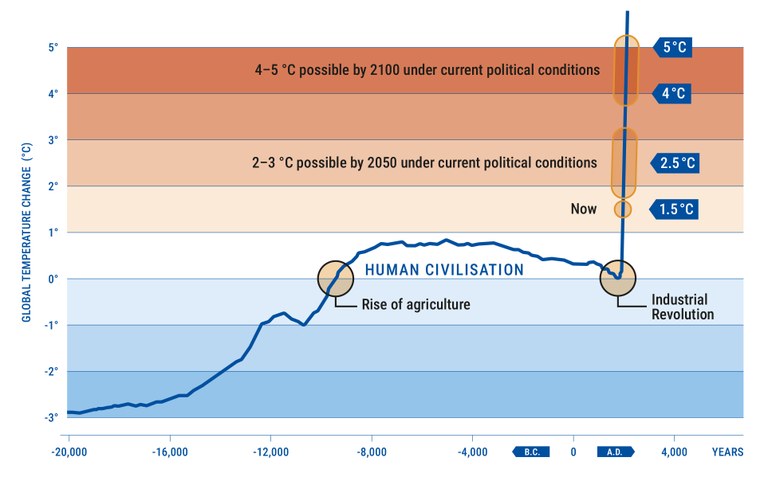
We can however not afford the consequences of fossil fuels. We are already severely impacted by global warming and it will get much worse very quickly. I think this chart conveys the severity of our situation very well: https://www.dpg-physik.de/veroeffentlichungen/publikationen/...
Affordability most definitely figures into which avenue forward should be taken. It cannot be used to justify fossil fuels over nuclear, but it can be used to justify renewables instead of nuclear.
Nuclear doesn't have a "get out of economics free" card just because fossil fuels are to be eliminated. I understand the desire of nuclear fans to pretend otherwise.
I'm not a "nuclear fan", I'm a "don't destroy the planet fan". I'm not saying we should build nuclear instead of renewables, I'm saying we should build it instead of fossil fueled generation. It seems you agree with this, so I'm not sure why you seem to be arguing against it.
Until the day that we stop burning fossil fuels entirely, we should be building nuclear to replace it. If it's more expensive that's fine, I don't think it would be, at least not significantly, but I can't prove it and I don't care either way, it doesn't matter. What matters is replacing fossil fuels as fast as possible. It's probably already too late, and the powers that be don't give a shit anyway so none of this will actually happen but this is what we should do.


I searched for "weather <my town>", I get an AI saying the current weather is 33C. It says monday will be 41C. Like I live in the desert. Google's actual weather widget, which appears BELOW the weather overview and gathers data from accurate sources, says 26C. How hard is it to block the "weather" keyword from triggering the AI overview when you already have a perfectly functional weather widget?
Also, because before we used to have a tool, there was even some sense of privacy in using that tool. Now with these LLM's pretending to be human, it feels like entering a store and instead of being allowed to browse things in peace a clerk starts pressing you about what you want in order to make themselves useful. At that moment the "privacy" of being able to just mind your own business, alone, vanishes. It's intrusive. And it becomes extremely clear how intrusive it is whenever you search for something by typing something to the SEARCH TOOL and the AI misinterprets it as YOU TALKING TO THEM AS A PERSON, e.g. if you type "how are you" and it says back "I am doing well, thank you for asking!" and things like that. Companies seem not to care about being as intrusive as possible in people's lives, it seems.
Maybe this is something cultural. iirc in America clerks are very proactive with interacting with customers, while in countries like Germany it's the opposite and they keep their distance.
reply